
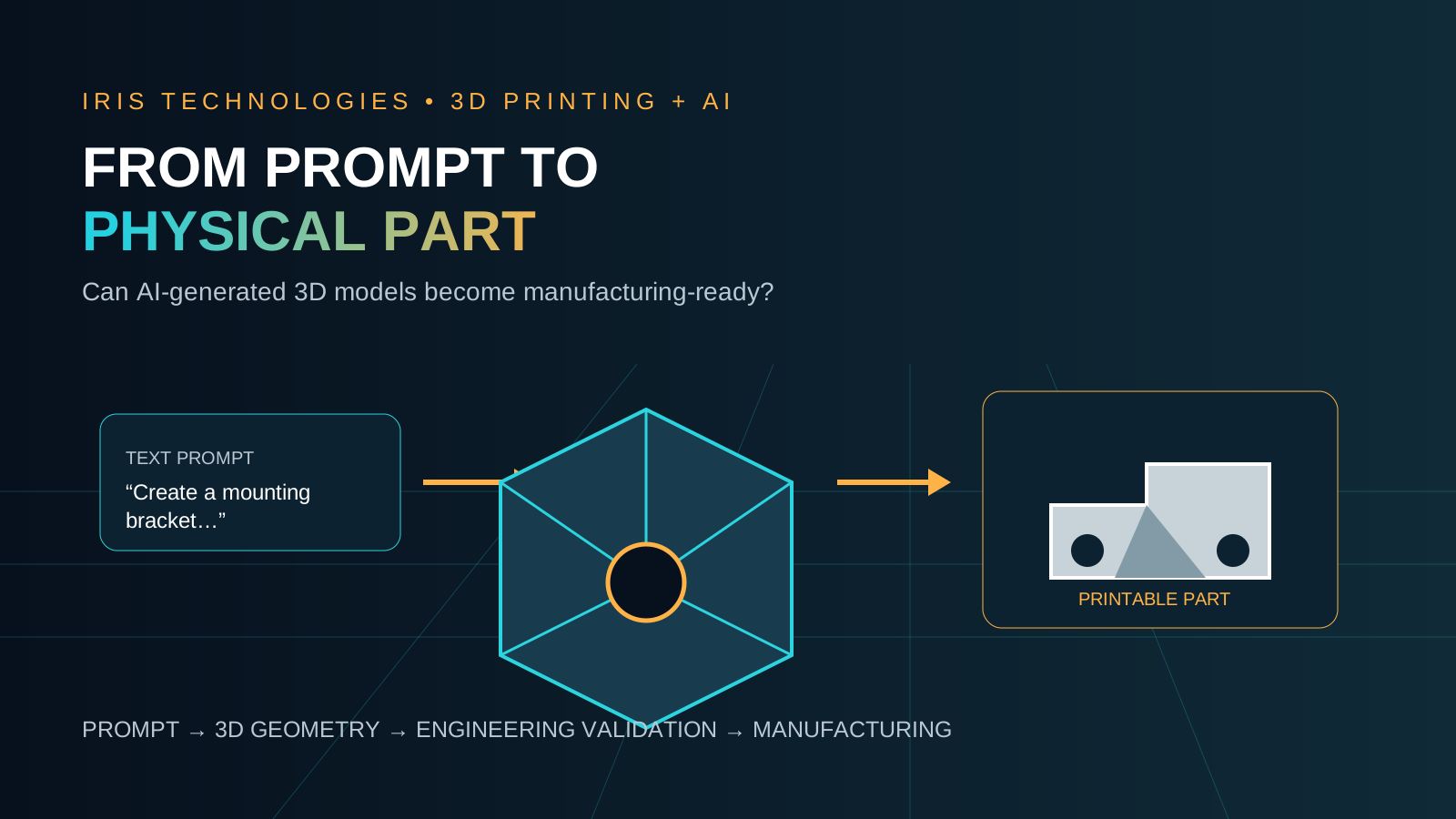
Imagine describing a mechanical component in plain English: “Create a mounting bracket with four bolt holes, a curved support and enough clearance for a cable.” An AI generates the 3D model. You send it to a slicer, press Print, and a few hours later the physical component is sitting on your desk.
That future is getting closer—but new research shows there is still an important gap between AI-generated 3D models and engineering-ready parts.
Researchers Put Text-to-3D AI to the Test
A study published online on 20 September 2026 benchmarked five commercial text-to-3D platforms—Meshy, PrintPal, Sloyd, 3D AI Studio and Tripo—specifically for additive manufacturing. Instead of decorative objects, researchers tested engineering components including an L-bracket, a print-in-place hinge and a cylindrical mounting bracket.
The prompts included dimensions, functional requirements and manufacturability constraints. This matters because generating something that looks like a bracket is very different from generating a bracket that fits bolts, maintains dimensional accuracy, withstands loads and can actually be manufactured.
The Current Limitation
The systems were generally capable of understanding the broad type of object requested, but engineering constraints were much harder. In the tested instances, different tools performed better on different components, but none produced a functional print-in-place hinge or a coherent cylindrical mounting fixture directly from the prompt.
The researchers concluded that current direct text-to-3D systems can be useful for ideation and early concept generation, while engineering applications still require CAD reconstruction, validation and manufacturing-aware preparation.
AI Is Moving Deeper Into Manufacturing
Text-to-3D generation is only one part of a larger transformation. Recent research is applying AI to reconstruct 3D CAD models from legacy 2D engineering drawings, assist additive-manufacturing quality inspection using vision-language models, and predict FDM build adhesion from STL geometry before printing.
Put these developments together and an interesting workflow emerges: Prompt → 3D Geometry → Engineering Validation → Print Preparation → Manufacturing → AI-assisted Inspection.
Why This Matters
For makers and designers, AI can shorten the distance between an idea and its first physical prototype. For engineers, it could reduce repetitive CAD and process-planning work. For manufacturers, the bigger opportunity may be connecting AI with existing engineering knowledge, CAD systems, production data and inspection.
And for people who do not know CAD at all, perhaps the biggest change is accessibility: a photograph, sketch or sentence could increasingly become the starting point for creating a physical product.
AI-generated does not automatically mean engineering-ready. Dimensions, tolerances, material selection, clearances, strength, orientation, support requirements and manufacturing processes still need engineering judgment.
The IRIS Perspective
At IRIS Technologies, the intersection between AI, digital design and physical manufacturing is particularly interesting. AI-assisted 3D generation can accelerate the creative stage, while CAD, engineering validation and 3D printing transform concepts into real objects.
Our view is that AI will not simply replace CAD. The workflow is more likely to become: Describe → Generate → Engineer → Validate → Manufacture.
Source note: the September 2026 text-to-3D benchmark was a single-instance benchmark per tool/prompt condition, so its results should not be interpreted as a universal ranking of platforms.