
Toyota Production Engineering and Rivian Automotive are among the early users evaluating Stratasys’ new F870 industrial FDM system for factory tooling, manufacturing aids and advanced prototyping.
And this is where things get interesting. 👇
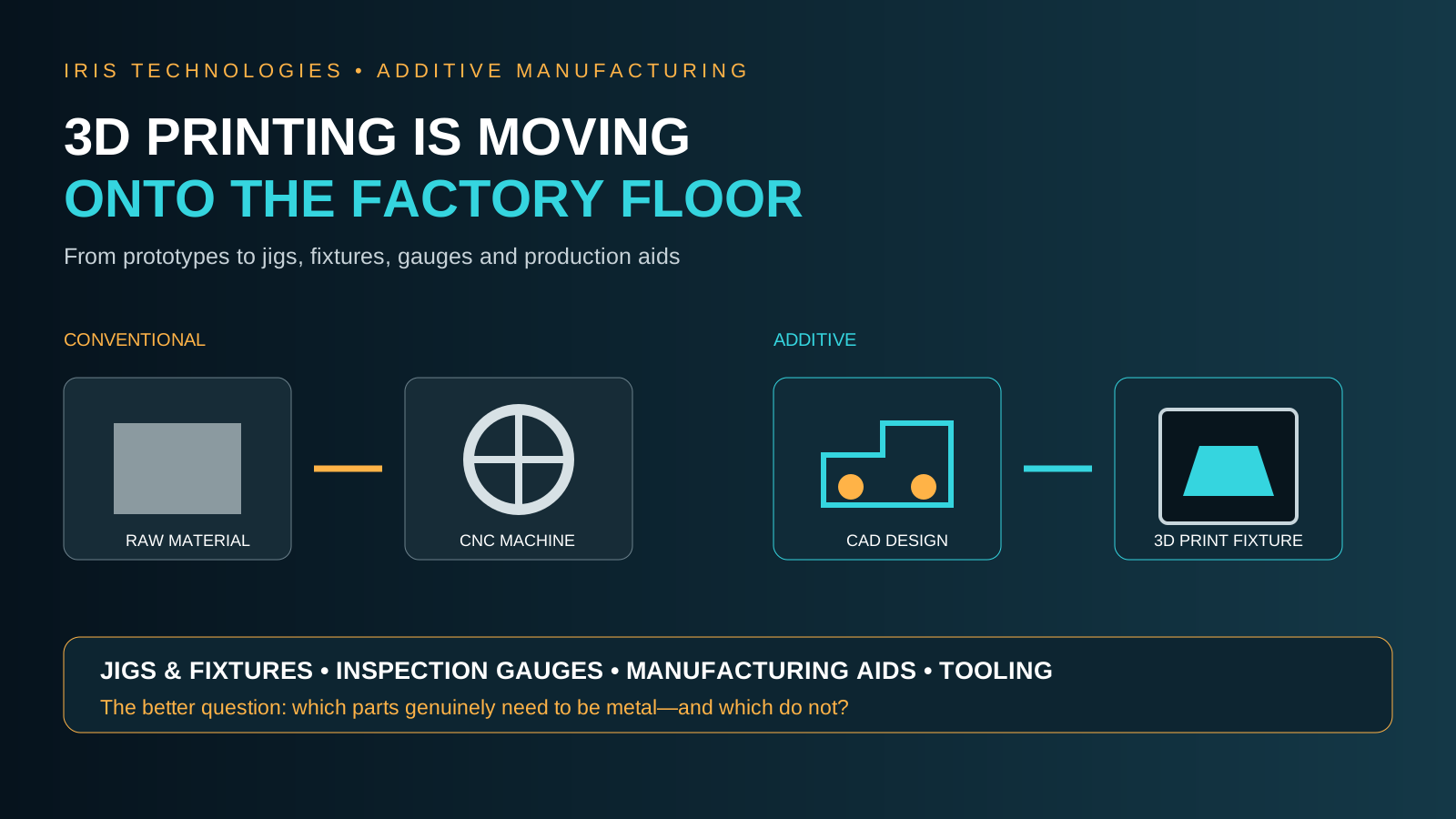
For decades, manufacturers have produced many jigs, fixtures, gauges and production aids through conventional machining. But for suitable applications, additive manufacturing offers another workflow:
This can be particularly valuable for low-volume tooling, frequently changing fixtures, prototypes and custom manufacturing aids.
A Large Industrial Platform
The F870 provides a 1,000 × 610 × 610 mm build volume in a fully heated chamber and supports engineering materials including Nylon 12CF, ASA, ABS and FDM ABS Draft.
But the bigger lesson is not about one printer. 💡 It is about changing how we decide what should be machined and what could be 3D printed.
Look Around the Factory Floor
Potential candidates can include ⚙️ jigs & fixtures, 🎯 inspection nests and gauges, 🤖 robot gripper components, 🔧 tool holders and assembly aids, 🛡️ machine covers and guards, 📐 drill templates and positioning aids, 🧩 low-volume custom components and 🚀 large prototypes.
Does everything belong on a 3D printer? Absolutely not. Loads, tolerances, temperature, wear, material properties, dimensional stability and safety still determine the correct manufacturing process.
Why This Matters
A useful first step for manufacturers is creating an AM opportunity list. Evaluate shop-floor items for quantity, size, load, tolerance, material, lead time, conventional manufacturing cost and frequency of design change. This turns 3D printing from a technology demonstration into an engineering decision.
The IRIS Technologies Perspective
At IRIS Technologies, we see the future as a combination of technologies rather than a competition between them. A printed fixture may speed up assembly. A printed prototype may validate geometry before CNC machining. A custom gauge may be produced additively while precision or wear surfaces remain metal.
CAD → Choose the right process → 3D Print / Machine → Test → Learn → Improve. 🔁
That intersection between digital design, additive manufacturing and conventional engineering is where some very interesting opportunities are emerging.
Sources: Stratasys’ September 2026 F870 launch information and TCT coverage of early Toyota Production Engineering and Rivian Automotive deployments. Application suitability requires case-specific engineering validation.